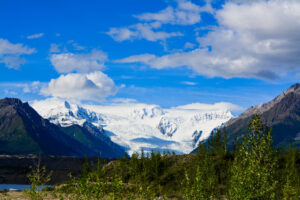
A sight to behold – we had heard Mount Rainier often referred to as the icon and most geologically prominent sight in the Pacific Northwest…after driving anywhere near it, we get it. We were able to see this awe-striking volcano when we were still 1-2 hours away from entering the park. Every turn it become a little bigger and our jaws dropped a little further. We entered from the Northwest, the Carbon River entrance, and had the fortune to spend summer solstice in shorts and a t-shirt with the mountain where we were blessed with the most beautiful alpine glow. On day 2 we drove around the mountain and didn’t see it a single time. On day 3 we were up in the Chinook pass and it was still so cold that the lakes were frozen over. On day 4 we were snowshoeing in light long sleeve shorts and sledding down the mountain on our butts.
What we are getting at is the mountain does create its weather and while it is a beautiful thing, make sure you come prepared. The weather may read 90-degree highs seven days from now but the next day it may read that it is snowing. Come prepared! Read the NPS website! Learn what marmots sound like before calling park dispatch! Have fun!
Core Memories from our time in Mount Rainier National Park:
- Snowshoeing from Henry M. Jackson Visitor Center to Pinnacle Point and Glacier Vista
- Sunset from Carbon River Road – the alpenglow was to die for
- Paradise River Trail sneaks in numerous rivers and gorgeous rivers
- Chinook Pass + Tipso lake was incredible while snowed over, we can only imagine what it would be like in the summer
Before we get into the content, I must share with you a few photos from one of the bet sunsets we’ve ever experienced


The Juicy Facts 🍏
Mount Rainier National Park is in Washington’s southwest region. The tallest peak in Washington State and in the Cascade Mountain Range of the Pacific Northwest, this active stratovolcano (last erupting about 1,000 yrs ago) stands at 14,411 feet above sea level and is home to the most glaciers in the country. Five major rivers originate from its glaciers, subalpine meadows surround its icy peaks, and old-growth forests cover its lower slopes. These diverse landscapes make up 369 sq miles and provide 260 miles of hiking trails. With an average yearly snowfall on subalpine meadows of 54 ft the native name Tahoma (or Tacoma), meaning “mother of waters” is extremely fitting. Mount Rainier is a nature lover’s dream as it greets visitors long before and after enjoying the park.
Mount Rainier became a National Park in 1899. Scientists, mountaineers, conservation groups, local businesses, and large railroad companies all saw some possible benefit from a national park around Mount Rainier and began a lobbying campaign in 1893. It was seen as potential stress for tourism from the nearby cities of Seattle and Tacoma; as well as a possible added expense to the government. However after congressmen received affirmation that the park would not come as an extra cost, the bill was passed in 1899. Mount Rainier became the nation’s fifth national park and the first to be established after the Forest Reserve Act of 1891 that created the U.S. Forest Service.
Park Zones:
Mount Rainier is the icon of Washington. As the tallest active volcano in the Cascade Volcanic Arc, it is the first and last thing you see in the National Park. Mount Rainier has five developed areas: Longmire, Paradise, Ohanapecosh, Sunrise, and Carbon River & Mowich. Although the level of development in these areas ranges from basic (little more than a campground and picnic area) to extensive (hotel, restaurant, visitor center, campgrounds, and picnic areas), each can serve as a base for exploring the rest of the park.
Longmire
Longmire is located in the southwest corner of the park. It became the park headquarters in 1899 with the establishment of Mt Rainier National Park. Previously James Longmire’s homestead, lodging, and mineral springs resort, Longmire is no longer the HQ but displays the original 1916 buildings. Across the street from the museum, the “newer” Longmire Administration Building, completed in 1930, still holds offices for park staff and is home to the Longmire Wilderness Information Center. Today it is now designated a National Historic District.
Camping:
- Cougar Rock Campground: This popular & spacious campground sits near the Nisqually River under the shade of an old-growth forest. **It is the only RV dump station in the national park.** (179 sites + 5 group sites).
Hiking:
- Narada Falls: No hiking required but couldn’t leave it off the list. This waterfall can be seen from the parking lot.
- Christine Falls: An epic view seen from the road with lush greenery and a historic arched bridge.
- Eagles Peak: 7.2-mile out-and-back trail with 3,054 feet of elevation gain. Depending on the time of year you may need snowshoes or microspikes! Check the All Trails comments to see what others are saying
Lookouts:
- Ricksecker Point
Paradise:
Paradise is located on the East side of the park. It is most known for its jaw-dropping views and wildflower meadows. It received its name from Martha, James Longmire’s daughter-in-law, who exclaimed, “Oh, what a paradise!” when she originally saw the site. The park’s main visitor center, the Henry M. Jackson Memorial Visitor Center, is located in the upper parking area with excellent views of the cascade mountain range. Paradise is the primary winter-use area in the park, receiving on average 643 inches of snow a year. Winter activities include snowshoeing, cross-country skiing, and sledding.
Hiking:
- Skyline Trail: Resting in the clouds at 5,400 this 5.5-mile loop displays glacier-fed lakes, hiking trails lined with wildflowers, and various rushing waterfalls – a “must do” for all first-time visitors. *We did this hike in June and it required snowshoeing. It was the favorite experience of our visit to the Park*
- Nisqually Vista Loop: Take it easy on this 1.1-mile paved trail with glacial views.
- Myrtle Falls: A waterfall situated right in front of one of the most iconic views of Mount Rainier. 0.25 miles.
- Reflection Lakes: This 2.75-mile hike leads you to the famous view of Mount Rainier’s reflection in the water.
- Alta Vista: This 1.8-mile loop with 616 feet of elevation gain starts near Paradise Inn and is best experienced July-October
- Pinnacle Peak: This 2.8-mile out-and-back trail with 1,423 feet of elevation gain is a challenging, yet beautiful route
Scenic Byway:
- Paradise Valley Road: Main road connecting most of the things above to either Stevens Canyon or Longmire
Ohanapecosh:
Ohanapecosh is located in the southeast corner of the park. Gaining its name for the Taidnapam (Upper Cowlitz) Indian habitation site along the river is thought to mean “standing at the edge.” Visitors can expect to experience the beauty and complexity of an old-growth forest compiled of Douglas-firs, western red cedars, and western hemlocks along with drier and sunnier climates of the west.
Camping:
- Opanapecosh Campground: Situated on the Ohanapecosh River, the Ohanapecosh Campground hides within a majestic old-growth forest. (179 sites + 2 group sites)
- Silver Falls: This popular 40 ft waterfall is reached by a riverside 2.7-mile loop set in an emerald forest and white water rapids.
Hiking:
- Grove of the Patriarchs: This grove of old-growth, 1000 yr old trees stretches 1.3 miles past towering western red cedar and Douglas-fir.
- Hot Springs Nature Trail: This 1-mile out-and-back trail is easy
- Silver Falls Trail: 4.0 mile, 705 elevation gain stroll to a beautiful waterfall
- Three Lakes Trail: 12-mile trail starting at Laughingwater creek takes you to as the name states, 3 lakes, each with beautiful views of Mount Rainier
Scenic Byways:
- Stevens Canyon: Epic 19-mile road inside Mount Rainier National park running between Paradise to the Southeastern entrance of the park. Check the NPS Website to make sure the road is open. We arrived in late June and the pass was still closed!
Sunrise:
Sunrise is located in the captivating Northeast corner of Mount Rainier National Park. Resting within the clouds at 6,400 ft, Sunrise is the highest point that can be reached by vehicle within the park and offers 360-degree views including the breathtaking Mount Rainier, Emmons Glacier, Mount Adams, and other volcanoes in the Cascade Range.
Camping
- White River Campground: The ideal gateway to the backcountry. (88 sites, First come, first serve)
Hiking:
- Wonderland Trail: No Rainier hiking guide is complete without at least a mention of the Wonderland Trail. This 93-mile hike circumnavigates Mount Rainier.
- Sourdough Ridge: This family-friendly 2.5-mile hike features amazing views of Mount Rainier, the alpine meadows, wildflowers, and marmot sightings.
- Burroughs Mountain: This 3.9-mile trail involves some serious elevation gain that results in dramatic views and burning lungs.
- Mount Fremont Lookout Trail: This 6-mile hike takes you through alpine meadows and past a frozen lake to reach your destination displaying the cascade range. *Bring your jacket*
- Mount Fremont Lookout: Home to sweeping views of Rainier and the surrounding hills, this 5.6-mile hike is a challenging one.
Scenic Highway:
- Chinook Pass: Awesome drive on the eastern side of Mount Rainier. This takes you to Tipso Lake and a gorgeous valley. Check the NPS website to ensure the road is open!
Carbon River & Mowich:
Carbon River is named for coal deposits found in the area, Carbon River is located in the park’s northwest corner. This part of the park receives consistently high amounts of rainfall so the climate and plant communities found here resemble that of a temperate rainforest. Mowich Lake is positioned in a glacial basin surrounded by wildflower meadows. The lake is the largest and deepest lake in the national park.
Camping:
- Mowich Lake Campground: Rustic wilderness campground (13 primitive sites, walk-in only)
- Ipsut Creek Campground: Backcountry (12 sites, *tent only*)
Hiking:
- Carbon River Rainforest Nature Trail: Take a 0.5-mile stroll through the only true inland temperate rainforest around Mt. Rainier.
- Tolmie Peak: Adventure up the steady uphill evergreen forest 6.5 miles to a lookout of Mount Rainier.
Additional Information on Places to Stay:
With over 2 million visitors flocking to Mount Rainier National Park annually the park provides a variety of overnight accommodations. There are five developed sections, including three car campgrounds & historic inns. These all serve as a jumping-off point for exploring the vast landscape of Mount Rainier’s trails & viewpoints.
Dispersed Camping *FREE*:
Mount Rainier National Park is surrounded by National Forests which provide advantages such as solitude, space, and adventure.*All National Forest lands are open to camping unless otherwise posted*. While there are many advantages there are a few drawbacks to wilderness camping including fire permit requirements, the need to bring or purify water, the possibility of floods, and having to properly dispose of human waste while in the forest. Remember “Leave No Trace”.
If camping isn’t your thing:
The National Park Inn: When James Longmire discovered Mount Rainier in 1883 he knew he found something special. By the summer of 1890 he & his family constructed & began operating the first tourist Inn on Mount Rainier. “Longmire Springs” offered a small two-story hotel of split cedar, with five small guest rooms upstairs and a lower floor lobby.
With the rest of the National Park, the family faced competition. In 1906 the construction of the National Park Inn, a three-story hotel accommodating 60 guests began operation. A fire destroyed the original National Park Inn in 1926.
Today the Longmire area is a National Historic Landmark District. The new National Park Inn offers 25 guest rooms, a casual dining restaurant, a guest lounge, and a country store.
For James Longmire, the sight must have been awesome as he approached Mount Rainier on a crisp morning in 1883. He was exploring from Puget Sound to Mount Rainier by following ancient Native American trails to make a main travel route. The discovery of hot springs was too good to pass up. He filed a claim, constructed a rudimentary trail & handcrafted a small cabin. His family, who had traveled west on the Oregon Trail 30 years earlier, joined him to build and operate the first tourist Inn on Mount Rainier.
By the summer of 1890, “Longmire Springs” offered a small two-story hotel of split cedar, with five small guest rooms upstairs and a lower floor lobby. James Longmire died in 1897.
Two years later, Mount Rainier was established as a national park. In 1906, the Longmire family faced their first competition with the construction of the National Park Inn, a three-story hotel that would accommodate 60 guests.
A fire destroyed the original National Park Inn in 1926.
The National Park Inn underwent renovation in1936 and 1990. The Longmire area was declared a National Historic Landmark District in 1987. Today, the National Park Inn offers 25 guest rooms, a casual dining restaurant, a guest lounge, and a country store.
The historic Paradise Inn: Nestled on the south slopes of the glacier-shrouded volcano at an elevation of 5,400 feet, the Inn hosts spectacular views of massive glaciers, meadows lush with wildflowers, breathtaking waterfalls, and wildlife. The Inn has undergone many transitions from 1895, “Camp of the Clouds”, which offered only a coffee shop called the Paradise Hotel, along with a tent camp to the Alaska cedar framed Paradise Inn of 1917 which supplied rooms for 37 guests and dining capacity for 400. The inn also built platform tent structures behind the Inn to house additional guests and meals were announced when the dining room manager blew a whistle from the back porch.
In 1920 with the increased demand for lodging, an addition to Paradise Inn was built having a 104-room wing named the “annex”.
In 1930, the tents surrounding the inn were removed and 275 housekeeping cabins, as well as a central service building with a cafeteria, camp store, & 40 guest rooms, were built.
The building was called the Paradise Lodge and opened to the public on June 20, 1931.
Construction of the Paradise Visitor Center (later renamed the Henry M. Jackson Memorial Center) was completed in 1966.
At $2 million, it was the most expensive building in the national park system and the modern design of the center was met with mixed reactions.
The Paradise Lodge was burned to the ground in 1965, during the construction of the visitor center, to make way for additional parking. The Paradise Inn remained standing however & was later listed on the National Register of Historic Places
(A smaller and more efficient visitor center opened in 2008, replacing the original structure.)